“The 70/30 architecture requires two diagrams: one for the technical layer, one for the social layer. Both are equal system components. One without the other is not an AI system.”
— Anton Lytvynenko, Chapter 7
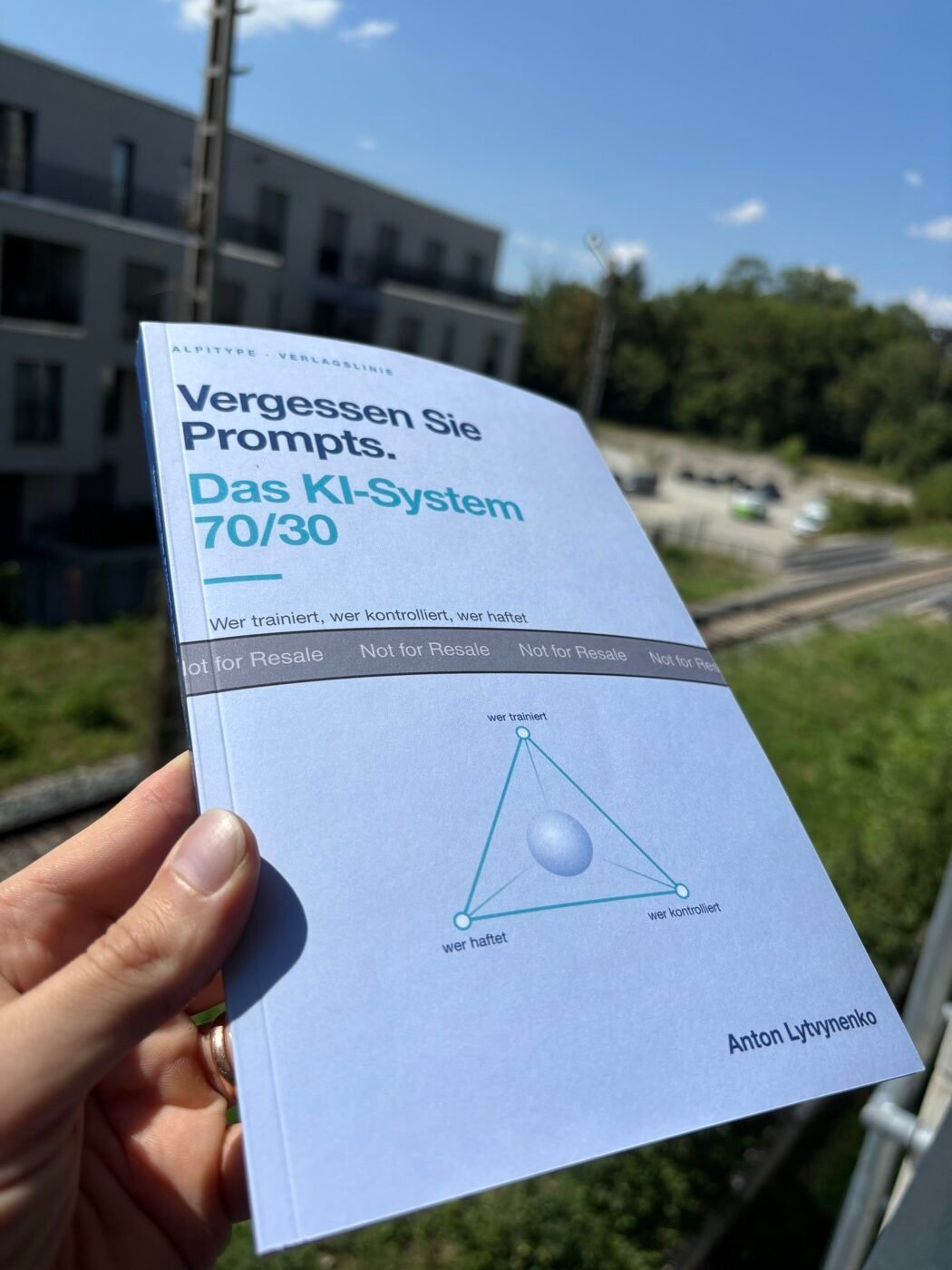
Who trains, who controls, who is liable
Any email address works · link valid 7 days · GDPR-compliant
“35 pages in — I’m hooked! The best book on the subject so far. Our CIO absolutely has to read this, I’d gift it. And this is exactly the kind of book I’d buy myself.”
The feedback follows the 70/30 architecture too: the machine assesses, the human decides.
Seven chapters open — the full 267 pages via email download. No newsletter · direct download · GDPR-compliant.
Also in the full book: Ch20 — Toward Neuralink · Ch10 Sovereignty · Ch13 Industrial AI ≠ SaaS AI · Ch22 AI Security.
AI projects rarely fail at the model; the model usually works. They fail because, after go-live, the system falls into a gap where nobody is responsible any more. The data scientist has moved on to the next pipeline. The engineer who keeps the models in operation watches monitoring dashboards whose alert thresholds he set himself.
What looks like a software problem is an anthropology problem. Three roles were never spoken out loud before the system went into operation. Three responsibilities were never assigned, three escalation paths never built: who trains, who controls, who is accountable. …
📄 Full chapter as PDF · free · no email: Deutsch · English · Українська
There is a hope that surfaces in almost every AI project. It is rarely spoken aloud, yet it structures everyone's expectations. The hope goes: if the model is large enough, it will fix the bad input data.
It will not. This concerns, above all, supervised learning — the family of machine learning in which a model trains on pairs of input and documented correct answer, the typical case of Industrial AI: quality control, predictive maintenance, credit scoring. …
📄 Full chapter as PDF · free · no email: Deutsch · English · Українська
In the spring of 2026, the Steuerberaterkammer Berlin — the Berlin chamber of tax advisers — files suit against the company Accountable. The accusation aims past the tool. There is no claim of harm to clients, no claim of wrong advice, no data leak. What is contested is a single word on the website: AI-Steuerberater — an AI tax adviser, where Steuerberater is Germany's protected professional title for tax advisers.
The case is more than a legal curiosity. It makes visible a pattern that sooner or later catches up with every productive AI vendor in a regulated domain: what stands before the court is, first of all, the position from which the model is sold — the model itself comes second. …
📄 Full chapter as PDF · free · no email: Deutsch · English · Українська
Regulation is the legal projection of the gap between machine generation and human verification. The EU AI Act, GDPR and their counterparts across the Atlantic leave cognitive asymmetry fully in place — they fix it in law.
The EU AI Act entered into force in August 2024. The transition periods for most high-risk categories have moved into their active phase or are entering it. Most machinery manufacturers in the DACH region have yet to feel the regulation's full weight. …
📄 Full chapter as PDF · free · no email: Deutsch · English · Українська
Almost every Industrial AI project carries an asymmetry that is rarely spoken about. It sits with the people who keep the system productive, and with the place that role is given in the company's organizational and economic structure; architecture, model choice and technology stack have little to do with it.
The challenge that industry discovers late — on a horizon of months after go-live, gaining weight gradually — lies in the phase of holding an AI system in a predictable state rather than in the phase of building it. …
📄 Full chapter as PDF · free · no email: Deutsch · English · Українська
Each of the four cases realizes the same mechanism: an error or an unusual result on the model layer travels all the way to the layer of legal and financial consequences, because none of the layers in between — signal, operator, mandate, documentation, contract — stopped it on the way. The layers are not accidental; each case below shows exactly which one stood empty.
Once an AI incident has happened, a convenient wording lies close at hand: the model hallucinated , the model broke , the model was not ready . Convenient, because such wording moves responsibility onto the technology and away from the organizational decisions that preceded the incident. The more useful optic runs the other way: look at the decisions that were never taken and the roles that were never filled. …
📄 Full chapter as PDF · free · no email: Deutsch · English · Українська
Bain & Company showed in a 2025 study: companies that combine generative AI with a genuine redesign of their processes cut costs by up to 25 percent. Companies that lay AI on top of existing processes, leaving the processes untouched, harvest single-digit percentages or nothing at all.[¹] That 25-percent figure is the strongest external evidence for the 70/30 approach. The technology on its own yields no economics; the economics come from constructing the human and technical layers together.
Most architecture diagrams of AI systems show the technical layer: the model, the data pipeline, the infrastructure, the integrations — sometimes with the user interface on top. …
📄 Full chapter as PDF · free · no email: Deutsch · English · Українська
Complete book as a free PDF — print edition available on Amazon
Anton Lytvynenko is a software systems engineer and adviser for AI adoption. More than thirteen years of industrial software in C++ — platforms, engineering tools and systems for industries where an architectural decision has a long life cycle: semiconductors, defence, aviation. To the author, AI is a continuation of software engineering — a system with inputs, outputs, interfaces, responsibility, risks and operating costs.

Author: Anton Lytvynenko, CEO AlpiType